
THORACIC OUTLET SYNDROME (TOS)
Thoracic outlet syndrome is a group of conditions characterised by compression or irritation of the brachial plexus and blood vessels (subclavian artery and vein) as they travel from the neck into the upper limb.
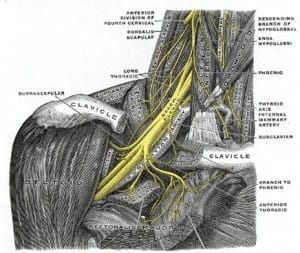
The passage of this neurovascular bundle can be compromised by any soft tissue or bony enlargement which reduces the small space within the thoracic outlet located between the collar bone and the first rib. This can be due to:
• An enlargement of the scalene muscles (anterior scalene syndrome) in the interscalene triangle.
• The presence of a rib in the lower part of the neck (cervical rib syndrome).
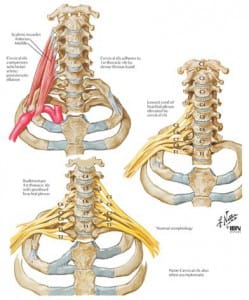
• Poor posture reducing the space of the costoclavicular triangle (costoclavicular syndrome).
• Tightness of the pectoralis minor in the subcoracoid space beneath the coracoid process (pectoralis minor syndrome).
The resultant compression can produce an array of symptoms dependant on the extent and location of the compression. It has been suggested that thoracic outlet syndrome can be subdivided into neurogenic, venous and arterial symptoms, however, the most common subtype is neurogenic accounting for 95% of cases (1) (Chang, 2010).
The clinical presentation of neurogenic thoracic outlet syndrome is similar to cervical nerve root irritation (C8-T1 more frequently reported than C5-7) and, as such, symptoms which may be reported include:
• Pins and needles in a specific dermatomal distribution. For the C8-T1 nerve root, changes in sensation are frequently felt in the ulnar nerve distribution, which is located on the inside of the forearm and hand. This symptom is often worse at night and often is noted in the whole hand, with the severity of symptoms being greater in the fourth and fifth digits.
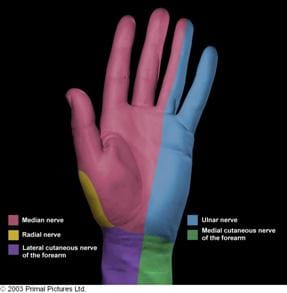
• Infrequently, weakness and wasting may be observed in the small muscles of the hand and in the finger flexors, leading to a reduced grip strength.
• Difficulty with fine motor tasks of the hand.
• Cramps of the muscles on the inner forearm (long finger flexors).
• Pain in the arm and hand.
• These symptoms may get worse by carrying heavy weights, using ruck sacs or having the arms above the head.
With compression of the subclavian artery and vein, vascular symptoms may also be observed, such as:
• Swelling or puffiness in the arm or hand.
• Bluish discoloration of the hand (cyanosis).
• Hand coldness and possible cold intolerance.
• Feeling of heaviness in the arm or hand.
• Deep, boring toothache-like pain in the neck and shoulder region which seems to increase at night.
• Easily fatigued arms and hands.
• Prominent veins in the hand.
(1) Andrew K Chang, MD, Associate Professor, Department of Emergency Medicine, Albert Einstein College of Medicine, Montefiore Medical Center.
J Stephen Bohan, MD, FACP, FACEP, Director, Observation Medicine, Department of Emergency Medicine, Clinical Director, Harvard Medical School, Brigham and Women’s Hospital.
Updated: Jan 25, 2010.
(The list of conditions given above and subsequent explanations are intended as a general guide and should not be considered a replacement for a full medical examination. Furthermore, we do not purport to treat all the conditions listed. Should you wish to discuss any of these conditions with our chiropractors, please do not hesitate to phone the clinic on 020 7374 2272 or email enquiries@body-motion.co.uk).
Our team of chiropractors and massage therapists are on hand to answer any questions you may have, so get in touch today via enquiries@body-motion.co.uk or on +44 (0)20 7374 2272.